Read the direction.
A relatively open grid leaves the ground colour visually prominent. Grid dimensions, line thickness and contrast belong in the brief as separate decisions.
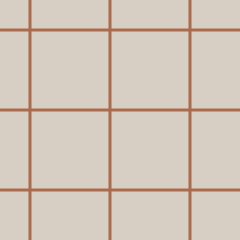
Compare the overall scale.
Review a full-repeat view to see whether the grid fits within a pocket, lapel or narrow side panel. A small swatch may contain only part of a window.
Record the structure.
Measure spacing between equivalent points, not the empty space between lines alone. Record the two repeat directions; do not assume a square grid.
Separate the colour decisions.
A quiet line can bring structure without dominating the ground. A strong accent line can remain visible at garment distance. Compare contrast without changing grid scale at the same time.
Place it on the garment.
Place the grid on a garment sketch before approval. Identify where lines should meet at fronts and pockets and where exact matching is less important.
A comparison you can take to the sample table.
Scroll the table horizontally on small screens.
| Decision | Record | Resolve with the next sample |
|---|---|---|
| Appearance | Windowpane tweed as the starting direction | Wider view of the entire repeat |
| Scale | Measured repeat, or a question if unknown | Physical scale reference |
| Construction | Important panel and matching points | Garment panel or prototype |
| Specification | Confirmed values and buyer targets separately | Composition, weight and usable width of the exact reference |
Fields for this pattern brief.
- Grid repeat and units
- Line thickness
- Ground and grid colours
- Front and pocket alignment
- Larger sample showing full repeat
Move from preference to approval.
Label the reference as inspiration, a candidate fabric or an approved requirement. Include the source and date. If the pattern is still open, compare one alternative using the same viewing scale and colour direction.
A pattern label does not confirm fibre content, performance, stock or development feasibility. Ask for the documented specification of the exact sample, and identify the decision you need the next sample to support.
Solve the next buying problem.
Why does a windowpane check disappear on a small sample?
A narrow cutting may contain only one line and hide the grid spacing. Ask for enough cloth to show the complete repeat in both directions, or a measured whole-repeat image for the initial discussion. Place the grid over the actual jacket or coat outline before deciding whether its scale works.
How do I avoid an awkward line through a pocket?
Mark the pocket position and the intended grid intersection on the garment drawing. Decide whether the line should continue through the pocket or deliberately break. Check that decision with the pattern maker across relevant sizes; a good position in one size does not automatically hold for the whole size range.